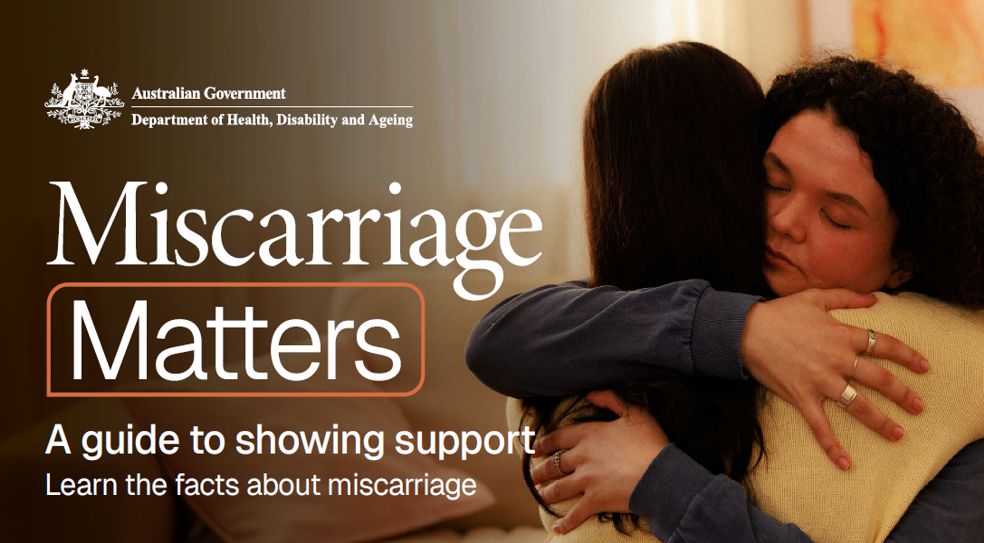
Miscarriage Matters: New national miscarriage education and awareness program to help break the stigma

Miscarriage Matters: New national miscarriage education and awareness program to help break the stigma and improve support for people experiencing early pregnancy loss.
The Department of Health, Disability and Ageing has launched a new miscarriage education and awareness program to help people in Australia better support those who have experienced miscarriage and early pregnancy loss.
“Miscarriage Matters” includes a number of resources to help raise awareness of miscarriage and aims to educate people in Australia on what to do or say to support someone. Suggestions for showing support include helping with chores, leaving a meal or flowers, and above all, being available to listen.
Miscarriages are more common than people may think. Miscarriage Australia estimates that 1 in 4 confirmed pregnancies end in miscarriage. That means approximately 285 families in Australia are affected every day.
While the data shows that many in the community experience early pregnancy loss, often it is a lonely experience – with cultural expectations, misconceptions, stigma and fear of being judged making it difficult for women to speak openly about their miscarriage.
Community Leader, Dr. An Nguyen, says despite cultural expectations it’s important that the Vietnamese community can address the cultural taboos and make a space where women and partners feel comfortable to share their experiences.
“For many Vietnamese families, pregnancy is a deeply valued experience that is often shared with family and loved ones. However, when a pregnancy ends unexpectedly, women and families can sometimes feel pressure to keep their grief private. These new resources from the Department of Health, Disability and Ageing provide an important opportunity to start conversations about miscarriage and pregnancy loss and help families understand that seeking support is a normal and important part of the healing process.”
The new resources provide guidance to help people feel more comfortable to have conversations about miscarriage, including providing information including what a miscarriage is and that it is not anyone’s fault. They aim to make space for conversation, understanding and compassion.
The resources also acknowledge that although it may be a difficult conversation to have, showing up and offering support is much more appreciated than saying nothing.
“In Vietnamese culture, care is often shown through actions rather than words. Supporting someone after pregnancy loss can mean checking in, preparing a meal, spending time together or simply being there without expecting them to explain how they feel. Sometimes the most important thing we can do is listen and remind people that they do not have to experience this alone,” continued Dr Nguyen.
Visit https://www.health.gov.au/miscarriage-matters to download today. If you or someone you care about has had a miscarriage, support is available. You are not alone.
About
The Miscarriage Education and Awareness Program and its resources have been funded by the Australian Government Department of Health, Disability and Ageing.
The program has been developed through significant consultation and testing with key audiences, experts, key advocacy groups and people with lived experience.
The program aims to raise awareness of miscarriage amongst the general population (including what it is, how common it is, and the impacts it can have), to make space for more open conversation, understanding and compassion.