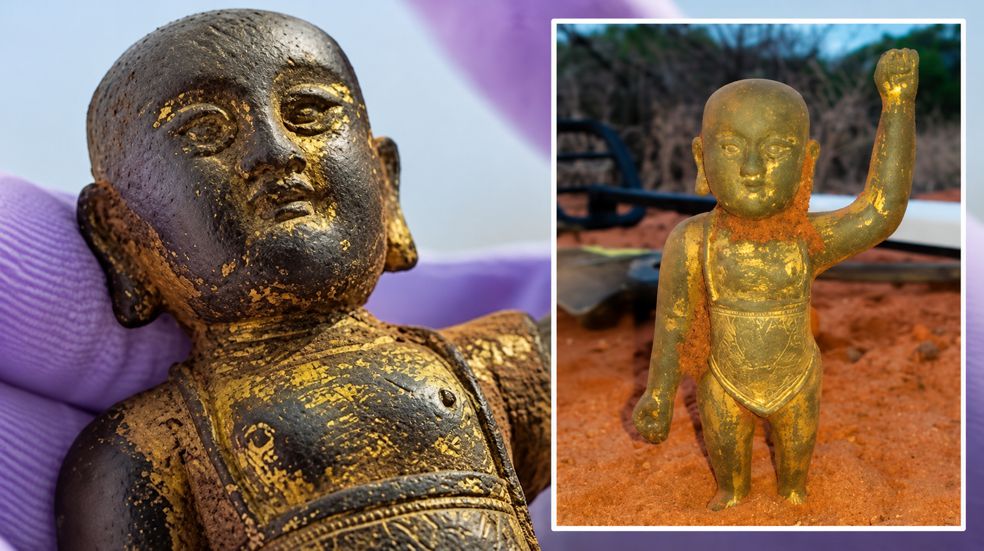
Australia returns 500-year-old Buddha statue to China
Australia has returned to China a bronze Buddha statue dating back approximately 500 years, which was discovered buried by the roadside in 2018.
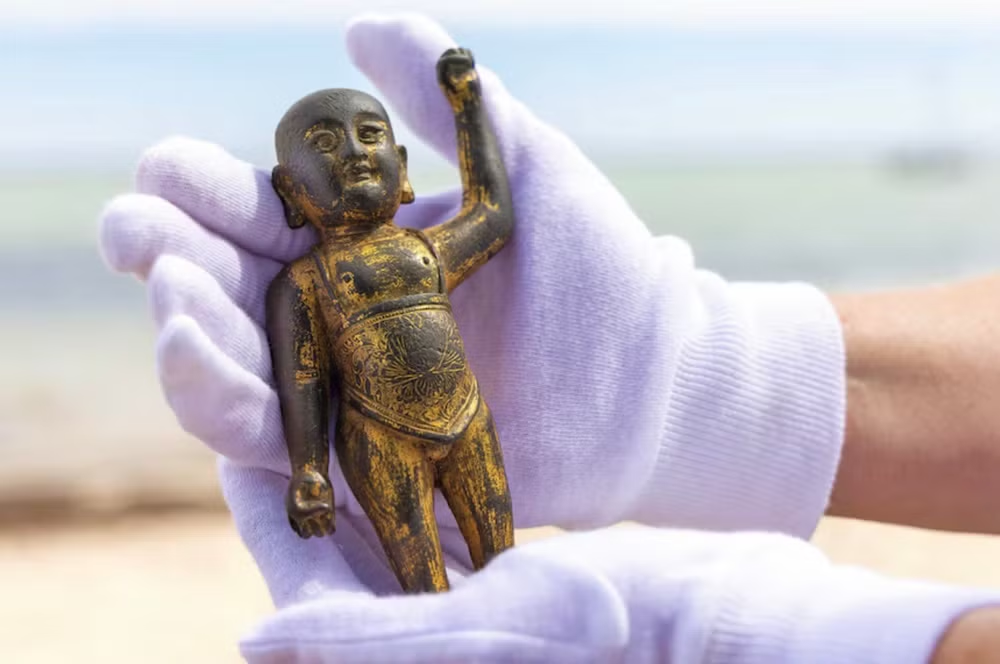
The statue was handed over to a representative of the Chinese consulate in a ceremony held in the coastal town of Denham, in Shark Bay, on October 13, according to ABC. The artifact will be taken to China for further historical research before being displayed at a museum in Beijing.
Australian filmmakers Leon Deschamps and Shayne Thomson had previously called on the Australian Prime Minister to support the return of a bronze Ming Dynasty Buddha statue to China as a symbol of peace and diplomacy.
This ancient statue of the Child Buddha was discovered by chance by the two men using a metal detector along a secluded road in Shark Bay, Western Australia, while they were working on a documentary project about the French expedition that took place from 1800 to 1803.
The small statue, measuring 15 cm in height and weighing over 1 kg, with its gold plating worn down over time, has been identified as a valuable artifact dating from the Ming Dynasty (approximately 1368 to 1644) and has been hidden in the red soil of northern Western Australia for the past 100 to 150 years.
The appearance of a Ming Dynasty Buddha statue in a remote sea area off Western Australia has sparked numerous historical theories. One theory suggests the statue may have been left behind by Admiral Zheng He’s treasure fleet during a voyage in 1421 under the Ming Dynasty. If true, this would mean the Chinese had set foot in Australia nearly 200 years earlier than the Dutch navigator Dirk Hartog (1616).
The theory supported by many experts is that the statue followed pearl divers or Chinese fishermen to Shark Bay in the 1870s. Shark Bay was the birthplace of the pearl industry in Western Australia from the 1850s, and once had a thriving Chinese settlement called “Canton” on Dirk Hartog Island with hundreds of laborers and wealthy shipowners. (CLO)